It isn’t that the salespeople aren’t good enough. It’s that the system that shows where growth leaks has never existed.
From The Pipeline Crisis in Swedish Industry (2026) — 7C Group’s field study of 39 Swedish industrial companies, cross-referenced with OMG, Gartner, McKinsey, Forrester & BCG.
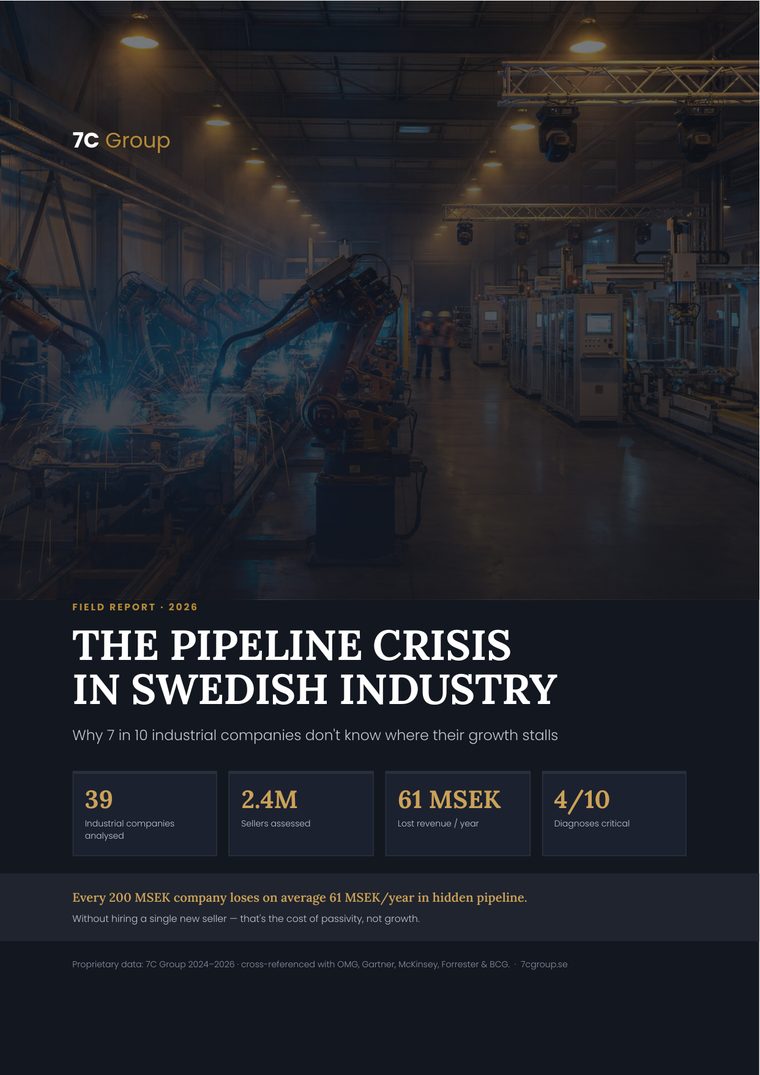
We measured 39 Swedish industrial companies from the inside. What we found was not a people problem.
have no pipeline visibility — they don’t know which deals are live or where in the buying process they are.
have no formal sales coaching.
of sales managers are strong at coaching.
of salespeople miss their quota.
A 200 MSEK company loses on average 61 MSEK a year in pipeline that is never visible — without hiring a single new salesperson.
This isn’t bad luck. It’s structure — and structure can be changed.
39 Swedish industrial companies, measured from the inside. The four diagnoses ranked by root cause, what inaction costs per quarter — calculated, not guessed — and an action plan for weeks 1–4.
Or book a free Pipeline Health Check — 30 minutes that show exactly where your growth is stuck and what it costs you every quarter.
Free. We email it straight away.
A new category is emerging: AI-native sales transformation — built for industrial SMEs. Not another dashboard on top of the CRM, but the layer that holds the entire commercial model, keeps it honest against reality, and makes it executable all the way down to who-does-what-today.
The transformation is coming either way. The only question is whether it is self-initiated — or forced on you by the market and the macro, and therefore reactive, late and more expensive than it needed to be.
Polnova is built for that category. From the ground up, with the domain — sales — in the driver’s seat. Not a technology idea in search of a problem.
Monday morning you see what you couldn’t see before: exactly where growth is stuck — which account, which role, which step — and whether the plan holds, before the year is lost.
Not more dashboards to interpret. One coherent truth about where revenue comes from, whether the plan holds, and what is drifting.
It sits above the salesperson: the right accounts, the right plan, the right activities — visible and coachable.
And it rests on an unusual rule: every number carries its basis. Anything unproven says “requires calibration” — never a guess.
LIS, the engine that fills the funnel, is live with paying customers. One example, anonymised:
In seven weeks a team of three sales engineers — after a half-day introduction — went from virtually no outbound activity to a working motion.
All five are live opportunities today. Not more names on a list, but a sales motion that actually runs.
Anonymised customer case · activity data from LIS in production · pipeline created, no revenue claims.
For those who are with us — here is how it fits together. GPS is the commercial model; four engines feed it. Every engine carries its status.
The plan that knows whether it holds. Takes the revenue target, subtracts what is already covered, and works backwards to what is required per seller and week — then decides whether the plan is even possible, before the year starts.
Turns market noise into a ranked, grounded target account list with an intelligence pack per account: signals, ICP scoring, pain and entry points.
See how LIS works ↗Captures the pain and the next step from the conversation, so a dialogue becomes a confirmed opportunity with a defined next step.
Finds grounded growth inside existing accounts — untapped potential against comparable customers, quiet decline before a customer is lost. A candidate to validate, never a made-up figure.
Behaviour, role, direction — per seller. A mirror of actual behaviour against the role’s bar.
The intelligence running through the entire platform — she explains, prepares the ground work and challenges. She never calculates herself; she asks the engines. Without a basis she says “requires calibration”, never a made-up number.
The moat isn’t the code — it’s the accumulated intelligence, sharper with every loop.
Better “I don’t know” than a polished guess.
Polnova’s consultative questioning method — Situation · Pain · Affect · Resolve, with example questions per step. Leave your details and you’ll get the PDF straight away.
We’re building the layer above every CRM — the system that makes sales judgement grounded, honest and coachable.
The hard part isn’t the interface, it’s the rule we hold everywhere: every number carries its source and its confidence, or it doesn’t ship — and that rule lives in code, not in good intentions.
It’s early. There is a real system to shape, not a finished thing to maintain. If you’d rather build something honest and hard than ship a polished, made-up demo, this is your room.
Open roles are advertised in Swedish only for now. If this is your kind of problem, write to lars@polnova.ai.
Something honest and hard, not a polished demo.
Book 20 minutes — we’ll show you where your growth leaks, and what it costs you every quarter.
Rather evaluate in your own time? Download the report
Questions about the platform, a demo or a partnership — get in touch directly.